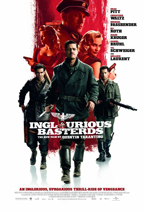
Inglourious Basterds: Additional Thoughts (2009)

Content by Tony Macklin. Originally published on August 26, 2009 @ tonymacklin.net.
After I write a review, I post it on rottentomatoes.com and IMDB. Both sites have a compilation of select reviewers' reviews.
On Rotten Tomatoes they have a rating that is favorable -- "fresh" -- and one that is negative -- "rotten."
When I sent them my review of Inglourious Basterds, for the first time ever they contacted me to recheck my rating.
I had written, "Some viewers will think it a masterpiece; others will think it an audacious hodgepodge. I think I'm among the latter."
Despite my immediate misgivings, I had given Inglourious Basterds a "fresh" rating. Rottentomatoes wondered if I had meant to.
I wrote them back that for me Inglourious Basterds was like "a beautiful woman with bad breath."
I was still trying to scope and cope.
It's a week later, and I'm still coping. I'm still in the dating process.
When I left the screening I had told a fellow critic, "that was a bad movie." But as I wrote my review, I pondered at length the good, the bad, and the ugly in Inglourious Basterds.
One of the good things is the opening sequence as a Nazi officer (Christopher Waltz) looks for hidden Jews in a farmhouse. It references Sergio Leone's Once Upon a Time in the West (1968) and spaghetti westerns.
Maybe that's why my review is a spaghetti review.
I'm a strong believer in the concept that "you don't like what you don't understand" (see Health Care "debate").
You should at least try to understand a film as it's meant to be understood. Once you get it, you can apply personal standards and also judge it on its own terms.
One of the major causes for a viewer's rejection of a good movie is that it isn't what he or she wants it to be.
When a movie is different -- Peckinpah's The Wild Bunch (1969) or Tarantino's Pulp Fiction (1994) -- it may startle or even offend our expectations. It may need a period of adjustment.
Inglourious Basterds is a movie that revises history -- it's the Jews who do the marking, it's the Jews who are ruthless, and it's the German high command that is immolated.
Tarantino unleashes the power of movies to change perceptions -- even history. In a climactic scene, nitrate film stock is used to destroy film... Film destroys film. What a metaphor!
Tarantino is still too cute -- when I heard the character Brad Pitt plays call himself Aldo Raines (allusion to actor Aldo Ray), I cringed.
The last line of the film is shaggy -- Aldo says, "This may be my masterpiece." That alone should assure it isn't.
Some of the sequences are almost draggy, particularly one in a cellar tavern. Scenes in a movie theater also lumber.
Tarantino indulges himself, but so did Peckinpah, Altman, Fellini, et al.
Inglourious Basterds is tantalizing. One of Tarantino's major themes is language, and it is a staple of Inglourious Basterds. Unlike most war movies, Tarantino has his characters speak in their native language.
I went so far as to interpret the character of the German actress (Diane Kruger) as a reference to Hildegard Knef, who changed her name to Neff when she came to America. Quentin has me leaping at shadows.
In the last week I've applied some critical mouthwash, and the beautiful woman is looking better than ever.
Now a long term relationship may be in sight.