The White Ribbon (2009)

Content by Tony Macklin. Originally published on March 26, 2010 @ tonymacklin.net.
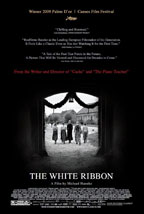
The White Ribbon is an austere allegory about a farming village and its inhabitants in Germany that can be interpreted as portending their future. In fact, it invites that interpretation.
The White Ribbon is set in 1913-1914; it ends in 1914 with the news of the assassination of Archduke Ferdinand of Austria -- an event that precipitated World War I. Horror is to come.
The children in the village will grow up to be in their 20s and 30s when Germany embraces Hitler and Nazism. The children are harbingers of a terrible future. They will participate in World War II.
The village in which the children live is controlled by authority. The land is owned and ruled by a baron (Ulrich Tukur) , and the church is commanded by a harsh, strict pastor (Burghart Klaussner). Only the local teacher (Christian Friedel) seems open and kind, but he has no power.
The baroness (Ursina Lardi) says she hates the "malice, envy, apathy, brutality" of the environment.
There's no anti-Semitism in the village, but the weak and vulnerable are abused. And the children are nearby when the abuse takes place.
Many of the children are beautiful -- with bright faces. Some very serious. Director/screenwriter Michael Haneke chose these faces to emphasize the innocence under siege.
The village has several events -- some called "accidents" -- that unsettle the townspeople because they are vicious and unresolved. Fear evolves.
The children are susceptible to influence -- one older child seems to exert particular influence. This especially portends the future.
Haneke released his German movie (subtitled) in black and white. It's narrated by an old man (Ernst Jacobi), who was the teacher in the village. He tells of the mysterious happenings in the village and his pursuit of love with a young woman (Leonie Bernsch).
Haneke's imagery is arresting. One of the major symbols he employs is doors. Violence and nastiness occur behind closed doors. Perversity, flogging, a suicide -- all happen behind closed doors.
Open doors reveal light, but at the end of The White Ribbon, doors are locked.
Religious symbols abound. Lethal scissors make a cross, and the shadow of a cross on the wall introduces fire. The movie ends in a church that goes dark.
It's a meaningful image in a foreboding, provocative film.